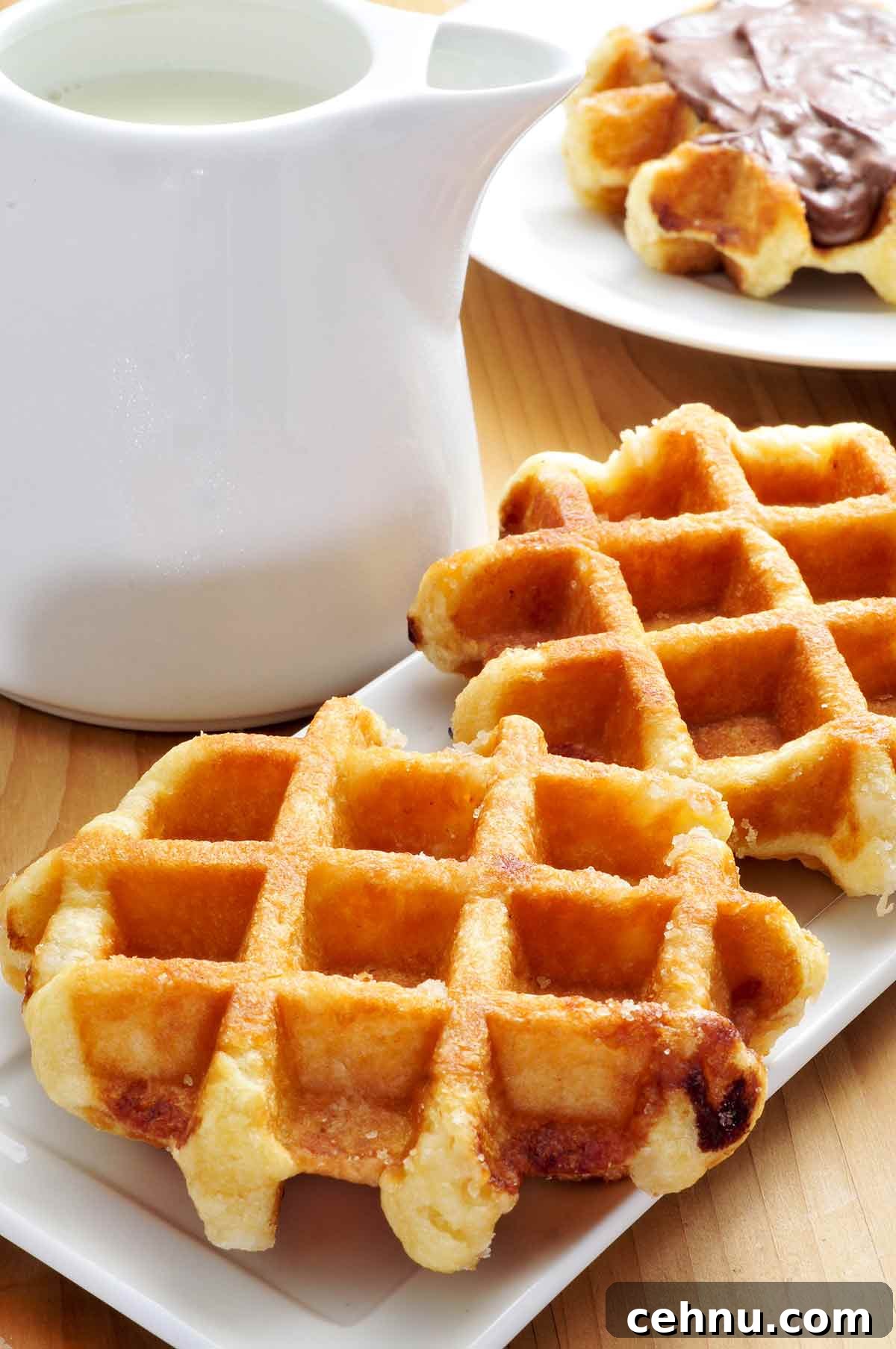
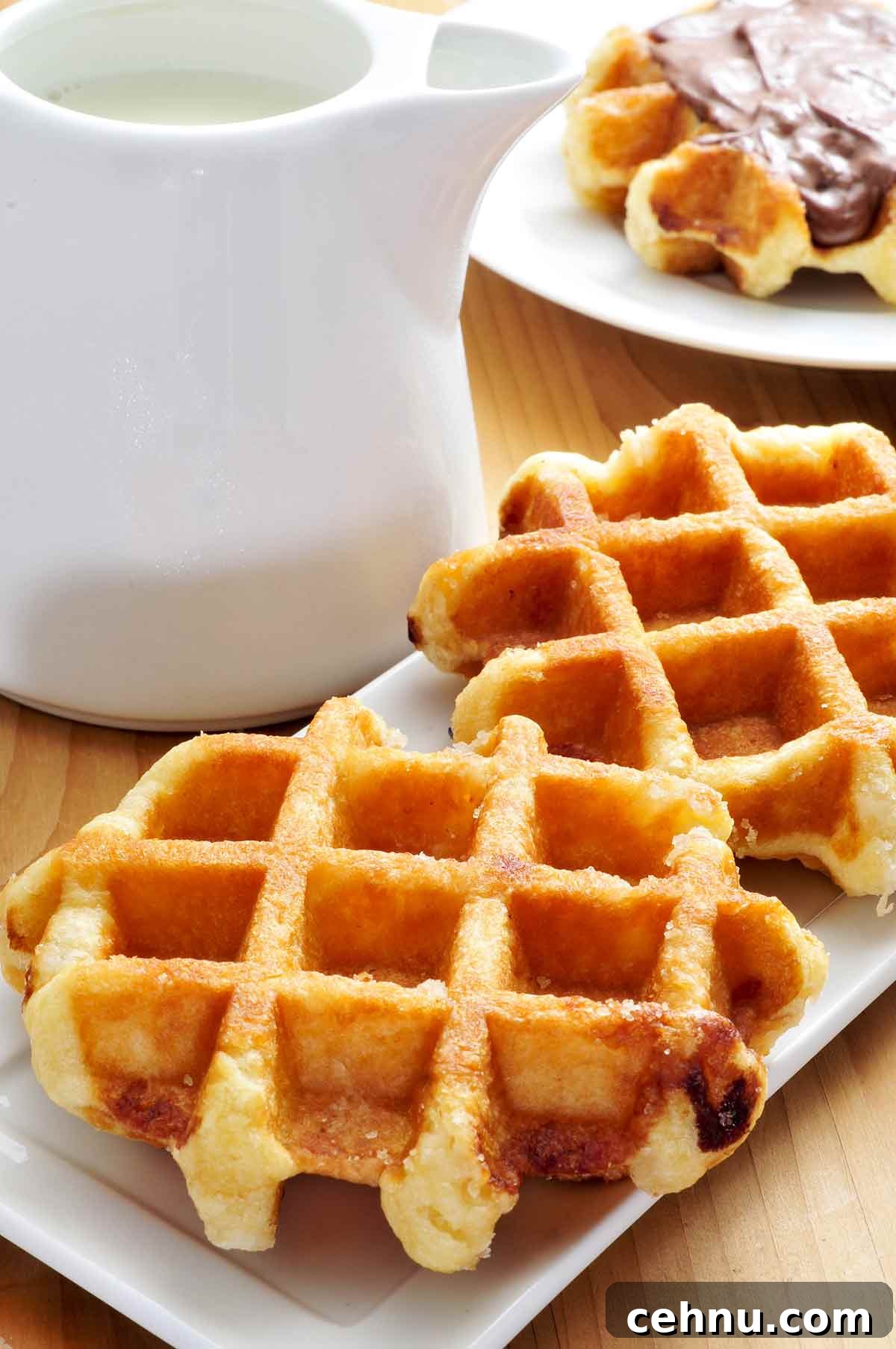
Belgian Liège waffles require time and attention, but the result is undeniably rewarding. Chunks of pearl sugar caramelize into a crisp, glossy crust while the yeasted dough yields a tender, slightly chewy interior that sets these waffles apart from ordinary recipes.
The first time I smelled them, I felt as if I’d been led by my nose straight to a small street bakery. It happened shortly after I moved to Brussels and wandered into a weekly farmers market. The aroma was irresistible: warm, buttery, and sweet. It drew me to a bright, mobile patisserie parked among the stalls. A steaming waffle iron hissed beside a display of delicate pastries. The vendor peeled a warm, oblong waffle from the iron, wrapped it in wax paper, and handed it to me. No syrup, no whipped cream—just a dense, caramelized waffle with a buttery, vanilla-scented interior. That first bite changed my idea of what a “Belgian” waffle could be.

In the United States, the name “Belgian waffle” generally refers to a lighter, fluffier style popularized at the 1964 New York World’s Fair. That version traces back to a restaurateur who marketed his creation under the name “Bel Gem,” which later morphed into “Belgium” and then “Belgian” on American menus. While related, that style—often leavened with yeast and beaten egg whites and commonly served with toppings—differs from the most common waffle found in Belgium itself.
The Liège waffle, which I first tasted at the market, is the most typical and the most enchanting to my mind. Originating in the town of Liège in southeast Belgium, it’s a rich, brioche-like dough studded with chunks of pearl sugar. Cooked on a very hot iron, those sugar pieces melt and caramelize, producing a glossy, crackly crust that encases a soft, buttery center. Locally, Liège waffles are eaten by hand and sold hot from street vendors; they’re often enjoyed as a snack rather than a formal breakfast.
Liège Waffles
Cuisine: Belgian |
Servings: 5 waffles |
Calories: 557 kcal per waffle
Cook time: 30 minutes |
Total time: 16 hours (including overnight rest)
Ingredients
- 1 1/2 teaspoons active dry yeast
- 1/4 cup scalded whole milk, cooled to 110–115°F (43–46°C)
- 2 tablespoons plus 2 teaspoons warm water, 110–115°F (43–46°C)
- 2 cups bread flour, plus more for dusting
- 1 large egg, room temperature, lightly beaten
- 1 tablespoon plus 1 teaspoon light brown sugar
- 3/4 teaspoon salt
- 8 1/2 tablespoons (4 1/4 oz) unsalted butter, room temperature
- 1 tablespoon honey
- 2 teaspoons vanilla extract
- 3/4 cup Belgian pearl sugar (or coarsely crushed sugar cubes)
Instructions
- In the bowl of a stand mixer, combine the yeast, scalded-and-cooled milk, and warm water until the yeast is just moistened—this takes only a few seconds. Add the egg and 2/3 cup of the flour and mix until incorporated. Sprinkle the remaining flour over the batter but do not stir. Cover and let rest until bubbles push up through the layer of flour, about 75 to 90 minutes.
- With the mixer on low, add the brown sugar and salt and mix until just combined. While the mixer runs, add the honey and vanilla, then incorporate. Add the butter two tablespoons at a time, mixing about 4 minutes on medium-low and scraping the bowl once or twice. Let the dough rest 1 minute, then mix 2 more minutes. The dough should cling to the sides of the bowl and, toward the end of mixing, begin to form a loose ball on the paddle. If not, rest 1 minute and mix 2 more minutes.
- Turn the dough into a lightly floured large bowl, cover with plastic wrap, and let rise at room temperature for 4 hours.
- Cover and refrigerate the dough for 30 minutes.
- Press the dough down gently to deflate. Transfer it to plastic wrap, shape into a long rectangle, fold like a letter into thirds to form a square, wrap, weigh it down slightly, and refrigerate overnight.
- The next day, place the cold, firm dough in a large bowl and add the pearl sugar. Mix the sugar in by hand until the chunks are evenly distributed. Divide the dough into five equal pieces, shape each into an oval, and let them rise, covered loosely, for exactly 90 minutes.
- Preheat your waffle iron. For a professional cast-iron iron, cook at 365–370°F (185–187°C) for about 2 minutes. For a regular home waffle iron, heat to 375°F (190°C) and cook 4 to 5 minutes. Because many home irons run very hot, consider placing the dough and then reducing or unplugging the iron briefly if necessary to prevent burning the sugar.
- Let the waffles cool a few minutes before serving. Wrap in wax paper for a traditional presentation, if desired.
Notes
What is scalded milk?
Scalded milk is milk heated to about 180°F and then allowed to cool to roughly 110°F. Historically, scalding killed bacteria and inactivated enzymes in unpasteurized milk. Today, with pasteurized milk the step is optional, but scalding can change the milk’s flavor and help integrate warm liquid ingredients, dissolve sugars, or melt butter when combined with yeast.
Nutrition (per waffle)
- Calories: 557 kcal
- Carbohydrates: 81 g
- Protein: 9 g
- Fat: 23 g
- Saturated fat: 14 g
- Trans fat: 1 g
- Cholesterol: 92 mg
- Sodium: 375 mg
- Fiber: 2 g
- Sugar: 43 g
Nutrition information is an approximation and should be used as a guideline.
Recipe Testers’ Reviews
This recipe passed a rigorous blind testing process and earned a place on the site. Testers highlighted its pastry-like texture and outstanding flavor.

Leanne Abe
These are the best Liège waffles I’ve tried. The crust caramelizes beautifully, and the interior has a buttery, malty, lightly yeasty flavor. Expect some non-active waiting time for the dough to develop flavor and texture. I used pearl sugar and also tried crushed sugar cubes; pearl sugar produced the best results. Kneading the sugar into the dough made distribution easier than stirring by hand.
I measured my waffle iron temperature with an infrared thermometer, and at 370°F the waffles cooked in about two minutes. Though it’s a bit of effort for five waffles, they’re rich and can be split into portions for sharing. Sugar and butter can stick to the iron—clean with a pastry brush and warm water while the iron is still warm.

Linda Pacchiano
Allow ample time for multiple rises and an overnight rest. Using a regular waffle iron heated to about 360°F, my waffles took five minutes and developed a caramelized exterior with a brioche-like interior. I made pearl sugar by crushing sugar cubes; it worked well, though some sugar melted onto the iron and required extra cleaning.